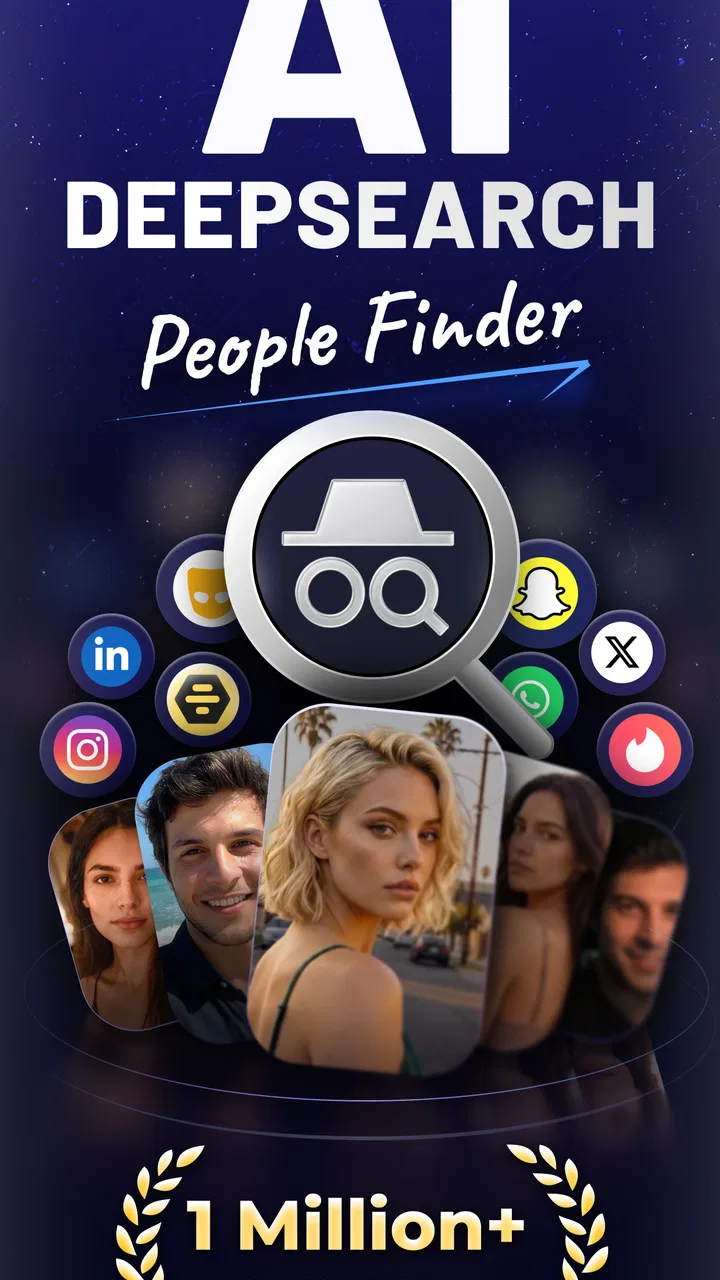
DeepSearch AI People Finder
- 4.3
- Rating
- 100.00K
- Installs
- Free
- Price

 Analysis by App-foxy
I approached DeepSearch AI People Finder as a practical lifestyle tool rather than a general social network. Its purpose is straightforward: help users find social media accounts through an AI-focused search experience. That sounds simple, but the usefulness depends heavily on how carefully you search, how you interpret results, and how you handle other people’s privacy. In my experience, it is most interesting for everyday coordination, reconnecting with someone, or organizing information that is otherwise scattered across social platforms.
The app is free to download, which makes it easy to test without committing money upfront. It is developed by HYPE Software LLC and sits in the lifestyle category, where it feels more like a personal utility than an entertainment app. The current release is version 1.5, and it runs on Android devices using version 7.0 or later. Its store summary is “Find Social Media Accounts,” while the shorter description presents it as “DeepSearch AI.” Those two phrases capture both sides of the experience: account discovery is the goal, while AI is the method presented to the user.
How it fits into a shared household routine
A realistic use case is a household preparing for a busy week. Someone has joined a local activity, received a contact name, or needs to reconnect with a person whose social profile is not easy to locate. Instead of asking several family members to search separately, one person can use the app as a starting point and then share only the relevant result through the household’s normal communication channel. This can save time when names are common or when a person uses different identities across platforms.
You May Also Like

 Blood Strike: 2.5 Anniversary
Blood Strike’s Loadouts Turn Every Drop Into a Tactical Gamble
A close look at Blood Strike’s custom loadouts: how fast access to signature weapons reshapes its battle royale rhythm, rewards preparation, and narrows the gap between fights.

 Pandora - Music & Podcasts
Pandora’s Music Is Easy to Start, but Harder to Recover
Pandora’s strength is its low-effort path from a seed to a station. Its weak spot is how much confidence it asks you to place in connection, setup, and quiet recovery.

 8 Ball Pool
 Is Built on Rivalries, Rematches, and Routine
A close look at the rivalries, rematches, shared routines, and unanswered safety questions that turn a quick pool match into a persistent mobile community.

 Samsung Music
’s Quiet Strength Is Playing What You Already Own
Its reach comes less from spectacle than from dependable access to a personal library. That simplicity is both the app’s strongest retention engine and its ceiling.

 AccuWeather: Weather Radar
AccuWeather Review: A Quick, Clear Forecast for Everyday Decisions
For everyday plans, the best forecast is the one you can understand quickly. AccuWeather makes rain timing, radar, and local conditions easy to act on, with a few trade-offs.

 Hill Climb Racing
Why Hill Climb Racing Still Turns Crashes Into One More Run
A tiny car, a bumpy hill and one more upgrade: Hill Climb Racing keeps resurfacing because its simple chaos makes every near-miss feel personal.
More From Our News Desk
View All News


I would not treat it as a permanent family directory. That is an important distinction. A search tool can help with a specific coordination task, but it should not become a reason to collect profiles, monitor people, or keep informal records about everyone a household knows. The most responsible workflow is to search for a clear purpose, check whether the result makes sense, and stop once the practical task is complete.
For shared-device use, the main question is not simply whether several people can open the app. The more important issue is account separation. If different household members use the same phone or tablet, I recommend deciding in advance who is responsible for each search and avoiding searches that mix personal errands with another person’s private curiosity. A shared device can blur boundaries quickly, especially when search history, suggestions, or previously entered names remain visible inside an app.
That makes a quick handoff routine useful. One person can complete a search, confirm the result, and close the app before passing the device to someone else. I also prefer using neutral descriptions when discussing results aloud. Saying that a profile appears to match the person being sought is more careful than announcing that the app has “found” someone with certainty. The wording matters because identity matching is an interpretation, not proof.
What I would do before the first search
I would begin with a narrow objective rather than typing a vague name and accepting the first appealing result. A full name, a known username fragment, a city, a profession, or a shared interest may help narrow the search, but I would only use details that are relevant and appropriate. The more context you provide, the more important it becomes to think about whether you are entitled to use it for this purpose.
In a household, I would also agree on a simple boundary: search for people you already know or have a legitimate reason to contact, not strangers selected because they look interesting. That boundary is especially useful when a device is shared with teenagers or younger users. The app may be rated for Everyone, but an age rating does not replace adult guidance about respectful searching, personal information, or contacting unknown people.
Another practical step is to separate discovery from action. Finding a possible account does not mean sending a message immediately, adding the person, or forwarding the result to others. I would first compare the visible details with what I already know, look for contradictions, and consider whether contacting the person through a known channel would be safer. This two-stage habit is one of the strongest ways to reduce mistakes.
Keeping family and personal searches separate
DeepSearch AI People Finder can be useful in a shared setting, but I would avoid treating one person’s search as everyone’s business. If a family member is looking for an old friend, that search should remain their responsibility. If another person is coordinating a group event, they may only need one confirmed account or a way to reconnect, not a collection of possible profiles.
This is where the app differs from ordinary contact management. A contacts app stores information that you or someone you know has deliberately saved. A social account finder works earlier in the process, when the identity may still be uncertain. That makes it more flexible, but also less dependable as a source of truth. For household organization, a confirmed phone number, email address, or existing group chat is usually better once the connection has been established.
I would also avoid using the app as a substitute for asking someone directly how they prefer to be contacted. Some people maintain separate personal and professional profiles, while others do not want to be contacted through social media at all. The app can help locate a possible route, but it cannot tell you whether that route is welcome.
Coordinating people without overstepping
The most convincing value I found is in short, practical coordination tasks. Imagine a neighborhood activity where the organizer knows a participant’s name but not the account they use for updates. A search may help identify a likely profile, after which the organizer can verify the person through the event’s existing channel. In that situation, the app is a bridge between incomplete information and a proper confirmation process.
A similar situation could arise when relatives are trying to reconnect with someone after moving to a new city. One person may remember a nickname, another may know a workplace, and a third may recognize an old profile image. The app can serve as a focused place to test those clues. I would still keep the final decision with the person who has the relationship, rather than turning the search into a group investigation.
One non-obvious tip is to treat each search as a hypothesis. Instead of asking, “Is this the person?” I would ask, “Which details support or weaken this match?” This changes the way the app is used. It encourages comparison rather than instant confidence, and it is particularly valuable when several accounts share similar names. A result that looks plausible at first may become less convincing when the location, interests, or public activity do not align.
Another useful habit is to record the reason for the search mentally before beginning it. If the purpose is to invite someone to an event, you need a reliable way to contact them. If the purpose is to verify whether an account belongs to a known person, you need corroborating details. If the purpose is simple curiosity, I would question whether the search is necessary at all. This small pause prevents the tool from encouraging aimless browsing.
There is also a trade-off between convenience and accuracy. An AI-assisted search may feel faster than checking several platforms manually, but speed can make weak matches feel authoritative. I would never use a result from this app alone for a serious decision involving employment, housing, safety, relationships, or accusations. In those situations, the consequences of a mistaken identity are too high for a casual discovery tool.
Where the usual alternatives are better
If I already have a username, a direct platform search is often the cleaner option. Searching within the relevant social network reduces the number of possible interpretations and keeps the task close to the place where the account actually exists. If I have a phone number or email address that the person gave me, saving it in a contacts app or sending a direct message through an established channel is more appropriate still.
Search engines can be better when the goal is to find a public professional page, official organization profile, or clearly published website. They also make it easier to compare multiple sources. On the other hand, they can return a large amount of irrelevant material, which is where a focused people-finding tool may feel more convenient.
DeepSearch AI People Finder makes the most sense in the middle ground: you have enough information to believe the person has an online presence, but not enough to locate the right account quickly. It is less suitable when you need verified identity, formal records, or a dependable contact database. I would choose the app for discovery, then switch to a more direct and trustworthy method for confirmation and ongoing communication.
Age, trust, and the limits of a shared device
The Everyone content rating makes the app broadly accessible, but I would still introduce it differently depending on age and maturity. Younger users may understand how to type a name into a search box without understanding the consequences of finding, saving, or contacting a stranger. A parent or guardian should explain that public visibility does not mean unlimited permission to investigate someone.
For teenagers, the most useful conversation is about judgment rather than prohibition. I would explain that a matching name or photo is not enough to identify a person, and that sending repeated messages after no response is not acceptable. I would also discourage searching classmates, teachers, or neighbors for reasons that could embarrass them. These rules are more valuable than simply presenting the app as safe because of its age rating.
For adults sharing a device, trust has a different shape. The concern is less about basic understanding and more about accidental exposure. A partner, roommate, or family member may see a name entered into a recent search and draw conclusions without context. I would therefore avoid using the app for sensitive searches on a device that others regularly access, or at least make sure the session is closed when finished.
One important limitation is that the app should not be mistaken for a family safety system. It is not a replacement for agreed check-ins, emergency contacts, parental conversations, or location-sharing tools that a household has deliberately chosen. Its role is much narrower: helping discover possible social accounts. Keeping that role clear prevents unrealistic expectations and reduces the chance of using it in situations where a dedicated safety solution would be more suitable.
Privacy is also a matter of behavior, not just settings. I would avoid entering unnecessary personal details about the person being searched, especially when a simpler query could work. I would not pass around screenshots of possible accounts unless there is a clear reason. If a result is wrong, I would treat that mistake as a signal to stop and reassess rather than adding more private information in an attempt to force a better match.
What the free model means in practice
The app is free to use in its basic download model, but it includes optional in-app purchases ranging from $3.99 to $79.99 per item. That wide range is worth noticing before anyone in a household starts experimenting. I would not hand the app to a child on a shared device without discussing purchases and checking the device’s normal purchase protections.
I also recommend deciding what a successful search is before considering any paid option. If the goal is to find one known account, paying more does not automatically make an uncertain match trustworthy. A paid step may improve convenience within the app, but it cannot replace confirmation from the person or from a reliable existing connection. For occasional household use, I would begin with the free experience and judge whether it solves a genuine recurring problem.
The app has an average rating of 4.3 from around 2.6 thousand ratings, and it has passed the threshold of 100 thousand installs. Those figures suggest that it has attracted meaningful interest, but they do not answer the personal questions that matter most: whether it recognizes the kinds of names you search, whether its results are easy for your household to interpret, or whether its workflow suits your privacy standards. I would use the rating as a reason to try it, not as proof that every search will be successful.
Its release date is April 9, 2026, and the version I reviewed is 1.5. That relatively early product stage makes me more cautious about building an important household process around it. I would keep a backup method ready, such as a direct platform search or a known contact route, rather than assuming the app will always be the quickest or clearest option.
My household verdict after weighing convenience and responsibility
I see DeepSearch AI People Finder as a targeted lifestyle utility for locating possible social media accounts when ordinary searches are inconvenient. I like the idea of using it as a first step in reconnecting with someone, coordinating a small group, or checking whether a public account may belong to a known contact. The AI-oriented approach gives the task a more focused feel than opening several social platforms one after another.
Its strongest use is not “finding anyone.” It is reducing the friction of a specific, legitimate search while leaving the user responsible for confirmation. That distinction is the app’s central trade-off. It can save time, but it may also encourage overconfidence if a plausible result is treated as a verified identity. My advice is to search narrowly, compare details, confirm through an appropriate channel, and avoid retaining information that is no longer needed.
For a household, I would recommend it only with clear boundaries around shared devices, age, and personal space. Adults can use it for practical coordination, while younger users need guidance about consent, contact etiquette, and the difference between public information and permission. If your main need is storing trusted contacts, direct messaging, or family safety, another type of app will serve you better.
Overall, I would keep it as an occasional discovery tool rather than a central communication system. The free entry point makes trying it reasonable, and the Everyone rating makes it broadly accessible, but thoughtful use matters more than convenience here. The best results come when the app starts a careful verification process, not when it becomes the final word about another person’s identity.
FAQs for DeepSearch AI People Finder
01What is DeepSearch AI People Finder and what can it do?
DeepSearch AI People Finder is designed to help users search for publicly available information connected to a person, such as online profiles, mentions, or other searchable web results. It should be viewed as a research and discovery tool rather than a guaranteed identity-verification service. Results depend on the information indexed online, the accuracy of the search details entered, and the availability of relevant public sources.
02Is DeepSearch AI People Finder free to use?
The app may offer limited searches or basic features at no cost, while more extensive searches, additional results, or advanced tools may require a subscription or in-app purchase. Before starting a trial or entering payment details, carefully review the pricing page, renewal terms, billing frequency, and cancellation instructions. Availability and prices can also vary depending on your country, device, and app-store account.
03Does DeepSearch AI People Finder reveal private or confidential information?
No legitimate people-search application should be treated as a way to access private accounts, confidential records, passwords, or restricted personal data. DeepSearch AI People Finder is intended to work with information that is publicly available or legally accessible. Users should respect privacy laws and personal boundaries, avoid harassment or surveillance, and never use search results to make sensitive decisions without independently verifying the information.
04How accurate are the results provided by DeepSearch AI People Finder?
Search results can be useful, but they are not guaranteed to be complete, current, or correctly matched to the person you are researching. People may share names, online information can become outdated, and automated systems can connect unrelated profiles. Treat every result as a lead that requires confirmation through reliable sources. Do not assume that a displayed match proves someone’s identity or background.
05What should I check before downloading and using the app?
Before downloading DeepSearch AI People Finder, check that you are installing the official version from a trusted app store and review its permissions, privacy policy, subscription conditions, and data-handling practices. Avoid entering unnecessary sensitive information, use strong account security, and confirm how searches and account data can be deleted. Also verify whether the app is available in your region and compatible with your device.
Pros
- Searches public information using AI-assisted queries.
- Can help connect scattered details about a person or profile.
- Simple interface makes searches accessible to nontechnical users.
- Useful for preliminary identity or background research.
- May save time compared with checking multiple search engines manually.
Cons
- Results may be incomplete
- outdated
- or incorrectly matched.
- Privacy concerns arise when searching for information about individuals.
- Some features or detailed results may require payment.
- Search quality depends heavily on the information entered.
- Should not be relied on for legal
- hiring
- or safety decisions.

DeepSearch AI People Finder
Gallery